
How to Monitor Competitor Visibility in AI Search: 5 Steps
Ask ChatGPT for the best emergency plumber in your city and it will often name just two or three businesses, each with a short reason attached. If yours is missing from that answer, the customer may never scroll down to find you.
That shift has turned competitor visibility in AI search into its own discipline. Traditional rank trackers show where you sit on Google but say nothing about which rivals ChatGPT, Gemini or Perplexity recommend when a buyer asks a direct question.
Below is a five-step routine for monitoring those rivals, built on one idea: treat each competitor as a profile you update every cycle, not a name on a list. It also covers the signals worth tracking and what to do when one competitor keeps getting named ahead of you.
What Competitor Visibility in AI Search Measures
Competitor visibility in AI search is the share of relevant AI-generated answers that mention a rival business. It is measured across a fixed set of prompts and AI engines, repeated over time. It shows who the engines recommend, how often, in what position and based on which sources.
Four signals do most of the work:
- Mention rate: the percentage of scans where a competitor appears for your tracked prompts.
- Position: being the first business named carries more weight than being the fourth.
- Framing: a competitor mentioned with a caveat or a lukewarm description is a weaker win than one named with a clear endorsement.
- Sources: the websites the engine drew on to build its recommendation.
One name in one answer tells you very little, so every signal above is read as a pattern across many prompts and many scans.
Why Spot-Checking Competitor Visibility by Hand Falls Short
Run the same prompt twice and the list of businesses can change. Phrasing shifts results too: “best roofer in Tampa” and “which Tampa roofer handles insurance claims” can surface completely different companies.
Buyers also spread their questions across ChatGPT, Gemini, Google AI Mode, Perplexity, Claude and Grok, and each engine draws on different data and weighs it differently. Checking 30 prompts by hand across six engines every week is not realistic, and one screenshot is a snapshot of a single roll of the dice.
Google’s AI Overviews appear inside regular search results, so they sit closer to organic rankings. Asking the AI engines directly is a separate measurement with separate data.
How to Monitor Competitor Visibility in AI Search
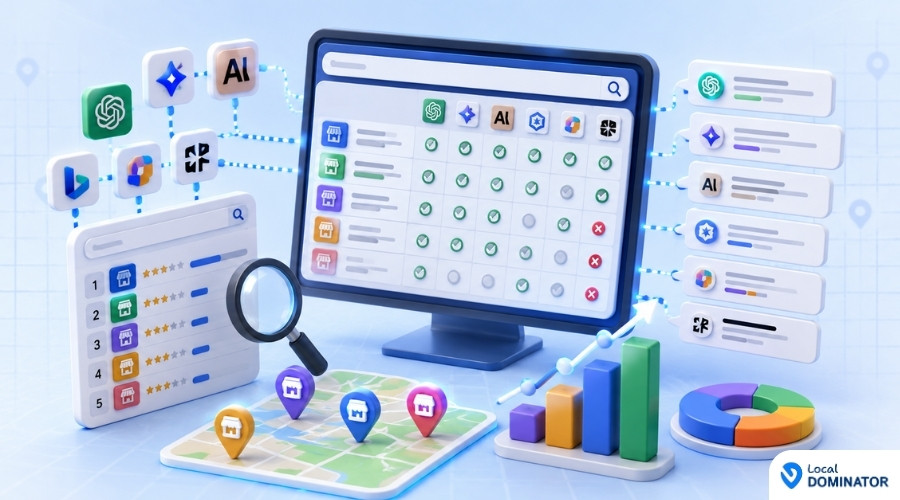
The most reliable method is to run one fixed prompt list across every major engine on a schedule, compare every brand that appears engine by engine, and read the sources behind each answer.
Step 1: Build a Prompt List to Monitor Competitor Visibility
Start with the questions buyers ask in their own words. Pull them from sales calls, review text, support emails and the search terms shown in your Google Business Profile Performance report. Good prompts combine a service, a location and a qualifier:
“Who is the most reliable garage door repair company in Mesa?” “Which dentist in Austin offers same-day crowns?”
A set of 20 to 50 prompts is a reasonable starting range to cover your core services and the neighborhoods you serve. A one-word prompt like “plumber” produces data too generic to act on.
Step 2: Run Competitor Visibility Checks Across Every AI Engine
Use the same prompt wording every time, across every engine, on a set cadence, because only repetition turns scattered answers into a trend line.
Breaking the results out per engine is the core of tracking competitors in AI answers, because a rival that dominates Perplexity can barely register on Gemini. Averages across all engines hide exactly the gaps you need to find.
Step 3: List Every Competitor the AI Engines Recommend
Record every business that shows up, including names outside the three competitors you already watch. AI engines often surface a franchise location, a directory listing or a newer shop with a strong review profile.
Rank each brand by mention rate and average position, then keep a one-line profile for each rival: where it appears, how it is described and which sources back it. Local Dominator, for example, groups this into a Brands tab that ranks every business mentioned across tracked prompts by visibility percentage and average position. Running the process through an AI tracker covering six engines turns a weekly guessing game into a repeatable data set you can compare month over month across ChatGPT, Gemini, Google AI Mode, Perplexity, Claude and Grok.
Step 4: Compare Competitor Share of Voice, Engine by Engine
Share of voice puts your visibility next to your rivals’. Compare your visibility percentage against the average of your top tracked competitors, one engine at a time.
Take a hypothetical case: you appear in 30% of Gemini answers while your top three rivals average 60%. Gemini is where the gap lives and where to start, even if ChatGPT looks healthy.
Step 5: Read the Responses Behind Each Competitor’s Visibility
Numbers show who is winning. The response text shows why. Read the full answers where a competitor beats you and note the reasons the engine gives: “open 24/7,” “specializes in commercial properties,” “highly rated for fast response times.”
Then check the sources. Many competitor wins trace back to specific domains, such as a local directory, a news mention, a comparison article, a forum thread or a detailed service page on the rival’s own site, and that list of cited domains becomes your to-do list. Add those domains to the rival’s profile so the next cycle shows whether the gap is closing.
When One Competitor’s Visibility Keeps Beating Yours
If one competitor keeps appearing ahead of you, work through these moves:
- Get listed or mentioned on the domains the engines cite for that competitor.
- Publish a dedicated page that answers the exact question you keep losing.
- If every answer mentions 24/7 service or insurance claims, make sure your site, reviews and business profile state the same facts, provided they are true for you.
- If your business appears with a negative or hesitant description, trace that language back to its source and address it.
Earning mentions on the sources the engines already trust for that rival often moves the needle faster than rewriting your pages to look like theirs.
How Often to Monitor Competitor Visibility
Check weekly if you work in a competitive category or run an active client campaign, and monthly at minimum otherwise. Agencies can package this as a recurring client deliverable, and a monthly view of who the AI engines recommend, and why, is often more persuasive than another rankings chart.
Watch the movement between scans more than any single reading. A competitor jumping from 20% to 50% visibility in a single month, for example, is worth investigating that week: pull its newly cited sources and see which prompts it took from you.
About Local Dominator
Local Dominator is a local SEO and AI search visibility platform built by a team of agency veterans and local SEO professionals. It helps marketing agencies and local businesses track and improve how they rank across Google Maps, search results, and AI answer engines from one dashboard, with rolling credits, bulk actions, and transparent, no-hidden-fee pricing.