Advanced Residential Soil Stabilization Techniques for Properties Built on Expansive Clay Ground
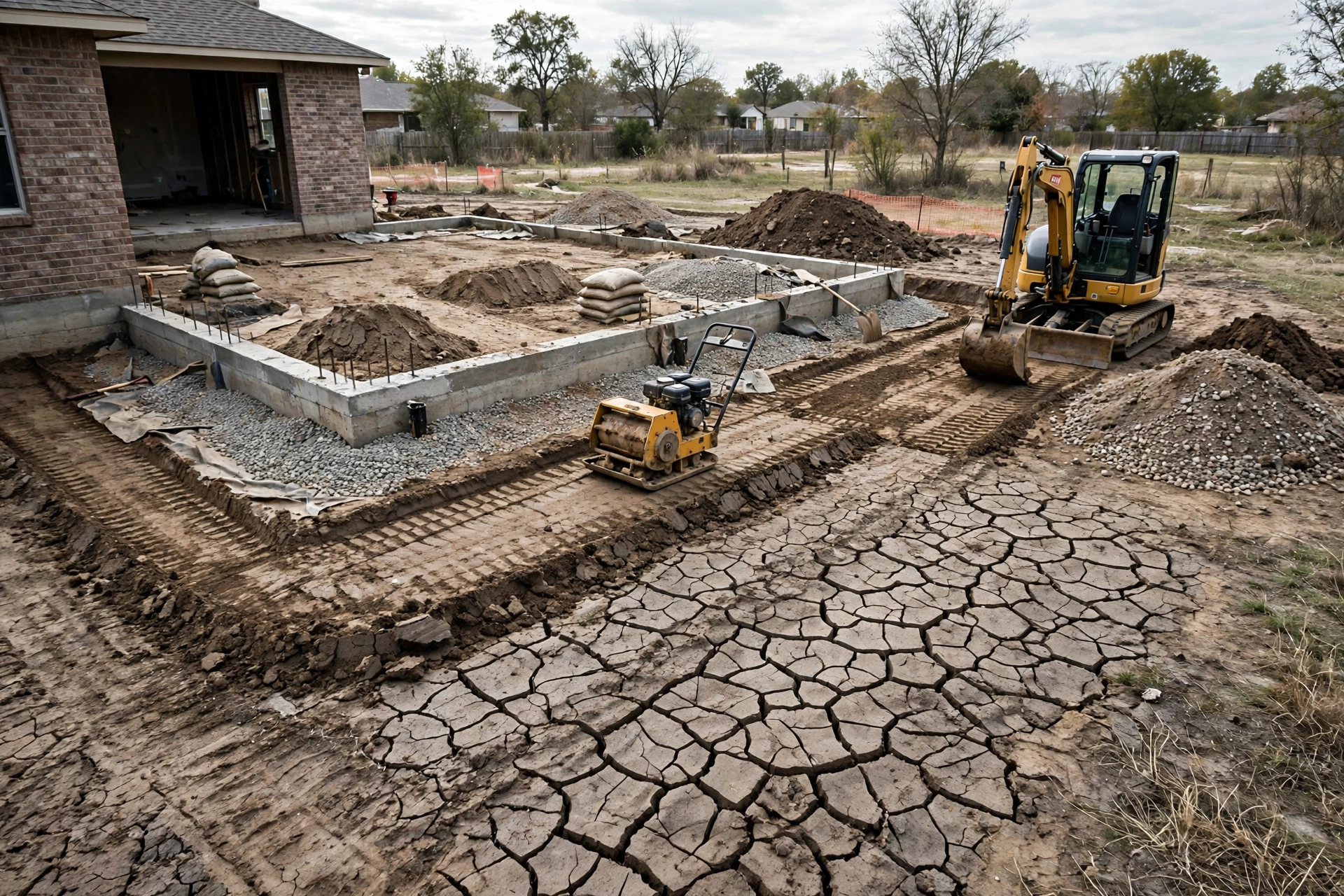
A house built on expansive clay lives on ground that breathes. In the wet season the clay swells, lifting the foundation a fraction of an inch; in the dry season it shrinks, and the foundation settles back down — rarely to exactly the same place. Over years of cycles, doors start sticking in summer and freeing up in winter, diagonal cracks creep across drywall, and floors develop a slope that was never in the original plans. The problem is not the house. It is the ground beneath it, and the fix is soil stabilization: treating the soil itself rather than endlessly patching the symptoms above it.
The direct answer is that stabilizing expansive clay means controlling moisture, changing the soil's chemistry, or bypassing the troublesome layer altogether — and usually a combination of all three. Drainage correction comes first, because no treatment survives a drainage problem that keeps re-soaking the ground. Chemical stabilization, lime treatment, and moisture conditioning then reduce the soil's ability to swell and shrink, while piers carry the structure past soil that is too deep or too active to treat. This guide explains each technique, when it fits, and what it costs in disruption and money.
The Seasonal Swell-and-Shrink Cycle Under Your Foundation
Expansive clay behaves like a sponge made of microscopic plates. When water enters, it slips between the clay minerals and pushes them apart, and the soil volume grows — high-plasticity clays can expand by twenty to thirty percent between their driest and wettest states. When the water leaves in a dry summer, the plates close up again and the soil shrinks. A foundation sitting on this material rises and falls a little with every cycle, and because moisture is never uniform around a house, different corners move by different amounts.
That uneven movement is what causes damage. A foundation that rose evenly would be harmless; a foundation where the north corner lifts half an inch while the south corner stays put is a foundation being twisted. The twist shows up as diagonal cracks at window corners, sticking doors, and gaps between the skirting board and the floor. Understanding the cycle matters because every stabilization technique is really a way of flattening it — either by keeping moisture steady or by making the soil less reactive to moisture changes.
What Expansive Clay Does Beneath a Foundation
Expansive clay damages homes through two linked mechanisms: heave and settlement. Heave happens when wet clay swells and pushes the foundation upward, often lifting the centre of a slab while the edges stay drier. Settlement happens when dry clay shrinks and the foundation drops, usually at the perimeter where sun and tree roots dry the soil fastest. Most homes experience both, in different seasons, and the repeated flexing fatigues the structure far more than a single movement ever would.
Smectite Clay: The Mineral Behind the Movement
Not all clay moves. The worst offenders belong to the smectite family, including montmorillonite and the Beaumont Clay that underlies much of Houston, Texas. Smectite particles have a layered structure that absorbs water between the layers, so the mineral itself swells. Kaolinite clays, by contrast, barely move at all. A geotechnical report that identifies the clay mineralogy is worth its cost, because it tells you whether you are fighting a genuinely expansive soil or a drainage problem wearing a clay costume.
Why Some Homes Move and Their Neighbours Do Not
Two houses on the same street can behave completely differently on the same clay. The difference is usually moisture: one home has gutters discharging at the foundation, a leaking supply line, or a large tree drinking from one corner, while the other has good grading and consistent watering. Cut-and-fill lots add another variable, because a home built partly on compacted fill and partly on native clay will move differently on each side. Stabilization starts with understanding your own home's moisture story, not your neighbour's.
Reading the Signs of Clay Movement Before You Spend a Dollar
Clay movement leaves a signature, and reading it correctly saves money because it separates a soil problem from a structural one. The signs that track the moisture calendar — worse in one season, better in another — are almost always clay. Cracks that grow steadily regardless of season point elsewhere, and a single event such as a burst pipe leaves a different pattern again. Before calling a contractor, spend a season watching and noting when each symptom appears and fades.
- Diagonal cracks at the corners of doors and windows that open in summer and close in winter.
- Doors and windows that stick in the wet season and free up when the soil dries.
- Gaps opening between skirting boards and floors, or between the fireplace and the wall.
- Sloping floors that change with the seasons rather than settling in one direction.
- Cracks in exterior brickwork that follow the mortar joints in a stepped pattern.
- Damp patches or pooling water against the foundation after rain.
Photograph every crack with a coin or a ruler for scale and date the photographs. A contractor who sees a dated series can tell in minutes whether the movement is seasonal clay cycling or progressive settlement, and that distinction decides whether stabilization, drainage work, or piers are the honest answer. A single photograph, by contrast, tells them almost nothing.
Drainage Correction: The Stabilization Step That Comes First
In most foundation cases, poor drainage is the primary driver of soil instability. When water consistently pools against or under a foundation, it creates exactly the kind of uneven moisture conditions that lead to differential heaving and settlement. Fixing drainage alone can dramatically slow or stop ongoing movement in many homes, and it is always the first step in any comprehensive stabilization program — because no injection, chemical, or barrier survives a drainage problem that keeps re-saturating the treated zone.
The standard recommendations are unglamorous and effective: regrade the yard so the ground falls at least 150 mm (6 in) over the first 3 m (10 ft) from the foundation, extend downspouts well away from the house, and make sure irrigation does not soak the soil against the walls. Gutters and surface grading are the cheapest stabilization tools a homeowner owns, and they should be fixed before a single dollar goes into chemical treatment or piers.
Chemical Injection, Lime Treatment, and Moisture Conditioning Compared
Once drainage is under control, the soil itself can be treated. The three main approaches work differently: chemical injection introduces stabilizing solutions deep into the ground, lime treatment changes the clay's chemistry so it swells less, and moisture conditioning pre-hydrates the soil so future swelling is reduced. None of them switches off expansive clay's appetite for water entirely — they reduce its reactivity and even out the moisture swings that cause damage.
| Stabilization method | How it works | Disruption | Best suited to |
|---|---|---|---|
| Water injection | Deep hydration pre-swells the clay | Low; small injection holes | Pre-construction pad preparation |
| Chemical injection | Binders reduce swell potential | Low; grid of injection points | Existing homes, moderate movement |
| Lime treatment | Lime alters clay chemistry | Medium; mixing or slurry | High-plasticity clays, new builds |
| Moisture conditioning | Soil removed, conditioned, replaced | High; excavation needed | New pads, shallow active zones |
| Polyurethane injection | Foam fills voids, compacts soil | Minimal; coin-sized holes | Loose fill, voids under slabs |
Injection methods are usually the least disruptive for an existing home: truck-mounted equipment drives rods into the soil on a grid — often around 1.5 m (5 ft) apart, in several passes — and introduces water or chemical solutions to depths of 2.5 to 3.5 m (8 to 12 ft). Lime treatment is more common on new construction, where the soil can be mixed properly. The right choice depends on the clay type, the depth of the active zone, and what the geotechnical report says — not on which method a contractor happens to sell.
When Piers Beat Treatment: Bypassing Soil That Will Not Stay Still
Some ground is too deep or too active to fix in place. When the troublesome clay runs six metres down, or when groundwater keeps re-saturating the treated zone no matter what the drainage work achieves, the honest move is to stop treating the soil and bypass it. Steel piers — push piers or helical piles — carry the structure through the moving layer down to strata that do not move, and the foundation is then supported by ground that stays still in every season.
- Deep settlement that continues despite drainage correction and chemical treatment.
- Active clay layers deeper than 4–5 m, where injection cannot reliably reach.
- Groundwater that accumulates beneath the structure and re-expands treated soil.
- Fill material over native clay, where the two layers move at different rates.
- Homes that have already been stabilized once and are moving again.
Piers are not a failure of stabilization — they are the correct answer to a different failure mode. A home that needs piers and gets another round of injection instead will keep moving, and the money spent on the second treatment is wasted. The geotechnical report, not the sales brochure, is what tells you which side of that line your home sits on.
Root Barriers and Moisture Barriers That Hold the Line
Trees are a significant source of localized soil moisture depletion. A large tree near a house can dry the clay beneath one corner through the summer, so that corner settles while the rest of the house stays put. Root barriers — vertical panels, typically HDPE plastic, installed in a trench between the tree and the foundation — force roots to grow downward rather than laterally toward the house. Installation depth is usually 600–900 mm (24–36 in), deep enough to redirect the root zone below the level where moisture fluctuations most affect the foundation.
Moisture barriers work on the opposite problem: keeping soil moisture consistent around the perimeter so the clay neither swells nor shrinks dramatically. A below-grade membrane or retention system around the foundation slows the movement of water in and out of the soil, flattening the seasonal cycle. Neither barrier fixes bad drainage on its own, but combined with grading and downspout work, they hold the moisture line that stabilization depends on.
Monitoring Movement After Treatment So Small Shifts Stay Small
Stabilization is not a fit-and-forget repair. The ground needs a season or two to prove that the treatment worked, and the only way to know is to measure. A follow-up elevation survey a season after treatment, compared with the pre-treatment survey, shows whether the foundation has stopped moving or merely slowed down. Crack monitors — simple glass or plastic gauges fixed across a crack — give the same answer week by week for the cost of a few dollars.
Record a full elevation survey and photograph every crack before any work starts.
Fix crack monitors across the worst cracks and read them weekly for the first season.
Keep a simple log of rainfall, irrigation, and any new symptoms alongside the readings.
Repeat the elevation survey after one full wet season and one full dry season.
Compare the two surveys before deciding whether more work is needed — not before.
Monitoring also protects the homeowner from paying twice. If the survey shows the foundation is stable, the job is done and no further work is needed. If it shows continued movement, the data points at the cause — a drainage path that was missed, a tree that was not barriered, or a deeper layer that needs piers — instead of another round of guessing.
Expansive Clay Stabilization Missteps That Waste the Whole Budget
The most expensive mistake in soil stabilization is treating the wrong problem. A home with a drainage failure gets chemical injection, the ground keeps moving, and the owner concludes that stabilization does not work — when in fact the right fix was a downspout extension and some regrading. The second most expensive mistake is the opposite: installing piers for a shallow, treatable clay layer that a simple injection program would have settled. Both mistakes come from skipping the geotechnical report and the drainage survey that should precede every stabilization decision.
Treating the Symptom While the Drainage Keeps Failing
Every stabilization method assumes the water reaching the soil is controlled. When gutters discharge at the foundation, when the yard slopes toward the house, or when a supply line leaks under the slab, the treated zone is re-soaked from the same source that caused the problem. The treatment then fails — not because the chemistry was wrong, but because the water was never stopped. Fix the water first, verify it with a wet-season check, and only then treat the soil.
Expansive Clay Soil Stabilization FAQs: Methods, Costs, and Timelines
How do I know if my soil is expansive clay?
Seasonal symptoms are the giveaway: cracks and sticking doors that worsen in one season and ease in another. A geotechnical report with soil testing confirms the clay type and its swell potential, and it is the only reliable basis for choosing between treatment and piers.
What is the cheapest effective soil stabilization?
Drainage correction — regrading, downspout extensions, and fixing leaks — is the cheapest and often the most effective first step. Chemical injection is usually the least disruptive treatment for an existing home, while piers cost more but solve problems that treatment cannot reach.
How long does soil stabilization last?
Chemical and lime treatments are generally considered long-lasting, often for the life of the structure, provided drainage is maintained and the moisture regime does not change drastically. Piers last as long as the strata they bear on. Any treatment can fail if a new water source appears, so monitoring matters.
Can I stabilize expansive clay myself?
Drainage work, grading, and root barriers are reasonable DIY projects for a careful homeowner. Injection, lime treatment, and piers are not — they need geotechnical design, specialist equipment, and monitoring. Doing them without a report risks treating the wrong layer or the wrong problem.
Will stabilization stop all foundation movement?
It should stop the damaging differential movement — the twisting that cracks walls — but tiny seasonal movements may remain. The goal is a foundation that moves so little, and so evenly, that the structure above it never notices. A follow-up survey confirms whether that goal was reached.
Final Thoughts: Stabilize the Ground First and the Foundation Will Follow
Foundation repair that ignores the soil is repair that will be needed again. Expansive clay is not a mystery and it is not unbeatable: control the water, treat the soil where treatment fits, and bypass it with piers where it does not. The homes that stop moving are the ones where the owner fixed the drainage first, followed the geotechnical report instead of the sales pitch, and measured the result a season later. Do those three things, and the ground beneath your home will finally hold still.