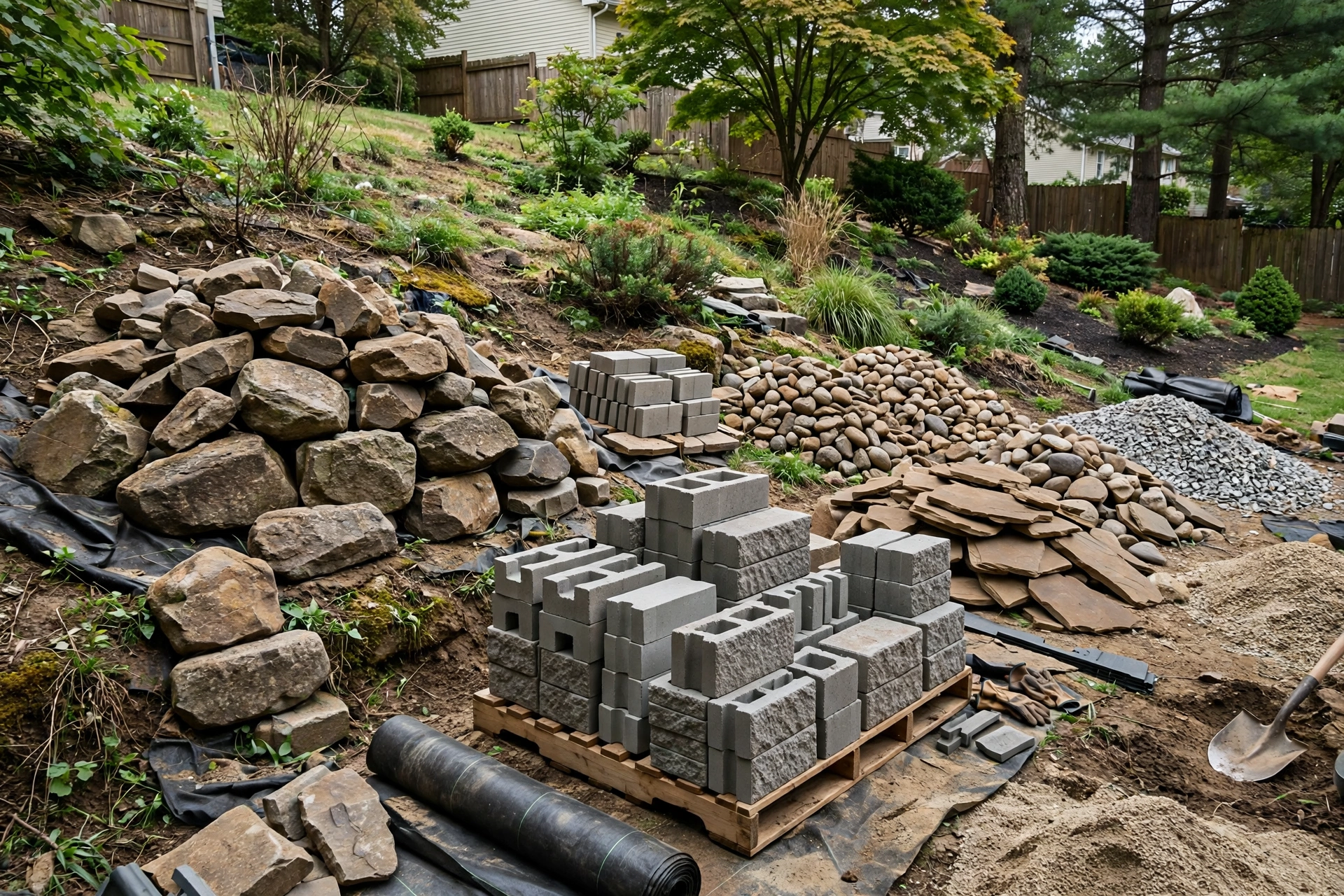
Decorative Retaining Wall Materials for Residential Gardens With Uneven Ground Levels
A sloping garden can feel like wasted space: banks that wash out in rain, beds you cannot stand on, and a lawn sliding toward the fence. A decorative retaining wall changes that. It holds back the soil, carves the slope into flat, usable terraces, and turns the level change itself into a garden feature worth looking at.
In short, the best decorative retaining wall material for a residential garden with uneven ground is the one that matches your wall height, soil, drainage, and garden style at the same time. Segmental concrete blocks suit most low garden walls. Natural stone suits premium, naturalistic gardens and lasts longest. Timber suits short, hidden walls on a budget. Gabion baskets suit wet slopes. For walls over about 3 to 4 feet, or any wall holding back a driveway or structure, get professional engineering advice first.
Uneven Ground, Usable Garden: What a Decorative Retaining Wall Actually Does
A retaining wall is not garden edging or a raised bed border. It resists the sideways push of soil, called lateral earth pressure, plus the extra push of water collecting behind it. That is why a wall that looks fine in its first summer can lean or collapse a few winters later if its base and drainage were skimped on. The decorative face is only the visible half; the buried base, gravel drainage zone, and drain pipe are what keep it standing.
Reading Your Slope Before Choosing a Retaining Wall Material
Material shopping comes second. First, read the ground, because the slope tells you how strong the wall must be and how much water it will handle.
Measuring the Drop and the Soil You Are Holding Back
Measure the total height difference from the top of the slope to the bottom, not just the height you imagine the wall being. A gentle bank of 2 feet can be held by almost any garden wall system, while a 5-foot drop usually means a taller engineered wall or two shorter terraced walls with a flat strip between them. Terracing is often the prettier and safer answer on steep gardens. Soil matters too: sandy soil can wash through gaps, while clay holds water and swells, pushing harder against the wall.
Where the Water Goes After Heavy Rain
Walk the garden during or just after heavy rain before you design anything. Note where water runs, where it pools, and whether it already undermines the bank. A wall built across a natural drainage path without an escape route will collect water behind it, and trapped water is the single most common cause of retaining wall failure. Give water a safe way out: gravel backfill, a perforated drain pipe at the base, and an outlet discharging away from the wall.
Seven Decorative Retaining Wall Materials, Weighed Side by Side
The table below compares the main options, using installed cost ranges from 2026 contractor pricing guides. Treat every figure as an estimate: local labour rates, access, and soil conditions move prices considerably.
Segmental Concrete Blocks: The Workhorse of Suburban Garden Terracing
Interlocking concrete blocks are the most common choice for residential garden walls. They lock together with lips, pins, or grooves, need no mortar, and come in colours and textures that mimic stone or weathered rock. They handle curves gracefully and are easy to repair one block at a time. Their weakness is appearance at close range: even good blocks read as manufactured.
Dry-Stacked Natural Stone: The Garden Wall That Looks Like It Grew There
Fieldstone, limestone, sandstone, and granite, stacked without mortar, give the most natural look of any garden wall, and the gaps between stones let water drain through the face instead of building up behind it. That natural drainage is a genuine structural advantage on wet slopes. The trade-off is cost and skill: every stone is a different shape, so laying a stable wall is a craft best left to a mason over about 3 feet.
Mortared Stone and Brick: Formal Faces for Front Gardens and Period Homes
When the wall will be seen from the street or must match a brick house, mortared stone or brick gives the crispest, most formal finish. A concrete block core faced with stone or brick veneer combines structural reliability with a premium face, though footing and veneer labour push costs toward the top of the range. Mortared walls need weep holes or drainage behind them, since water cannot seep through the face.
Boulder Walls: Big Rocks for Big Level Changes
Boulder walls use large, irregular rocks placed by a small excavator, and they suit gardens where a rugged, landscape-scale look fits. They are fast to build once machinery is on site and extremely durable. They need machine access, so narrow side passages rule them out.
Pressure-Treated Timber: The Budget Answer for Low, Hidden Garden Walls
Stacked pressure-treated timbers are the cheapest way to hold back a low bank, and they suit rustic gardens, raised vegetable beds, and walls hidden behind planting. Expect roughly 10 to 20 years of service, shorter in constantly wet ground. Avoid old railroad ties from salvage yards: they can contain creosote, which leaches into garden soil and harms plants. Timber is a poor choice for front-garden feature walls or walls over about 3 to 4 feet.
Gabion Baskets: Wire Cages That Turn Drainage Into a Design Feature
Gabion walls are wire mesh baskets filled with stone. Because they are permeable, water passes straight through them, removing the hydrostatic pressure that destroys other walls on wet sites. They look modern and sculptural, flex slightly with ground movement instead of cracking, and can be softened with trailing plants. They suit larger gardens and erosion-prone slopes, though the visible mesh is not to everyone's taste.
Poured Concrete With a Decorative Face: The Tall-Wall Specialist
Poured, steel-reinforced concrete is the material for tall walls, walls carrying driveways or structures, and walls needing maximum strength in minimum thickness. On its own it reads as industrial, so residential projects usually face it with stone veneer, render, or cladding. It is not a DIY material: formwork, reinforcement, and curing all need experience.
Matching a Retaining Wall Material to the Garden Around It
A wall that fights your garden's style will look wrong no matter how well it is built. In a cottage or woodland garden, dry-stacked stone and weathered timber blend with planting and mature trees. In a modern garden, smooth-faced blocks, gabions, or rendered concrete suit the architecture. Around a period brick house, brick or stone veneer ties the garden to the building.
The Hidden Half of Every Garden Retaining Wall: Base, Batter, and Drainage
Whatever material you choose, the buried construction follows the same principles. Skip any of them and even the best-looking wall is living on borrowed time.
Start with a level, buried course. Dig a trench and compact a level base of crushed gravel, at least 6 inches deep, burying the first course partly below ground.
Build with a slight batter. Lean the wall slightly back into the slope, about 1 inch per foot of height, so it resists soil pressure.
Backfill with gravel, not soil. Place at least 12 inches of clean crushed gravel directly behind the wall, full height, with filter fabric keeping soil out of it.
Give water an escape pipe. Lay a 4-inch perforated drain pipe at the base of the gravel zone, sloping to a daylight outlet or storm drain.
Compact in layers. Compact backfill in thin layers as you build, rather than dumping a full load of soil behind a finished wall.
For walls approaching 4 feet, many block systems add geogrid, a plastic mesh extending back into the soil that ties the wall to the bank. It signals the project is crossing into engineered territory.
What a Residential Garden Retaining Wall Tends to Cost
As a rough planning guide, most residential garden retaining wall projects land between about $3,000 and $10,000 in total, according to 2026 contractor pricing guides. A 50-foot wall that is 3 feet tall has 150 square feet of face: roughly $2,250 to $3,750 for timber, $3,000 to $5,250 for segmental block or gabion, and $3,750 to $7,500 for mortared stone. Get two or three local quotes covering the base and drainage, not just the visible face.
Retaining Wall Blunders That Split, Lean, or Bow Within a Few Years
Most failed garden walls fail for the same handful of preventable reasons. Building on uncompacted soil instead of a gravel base lets the wall settle unevenly and crack. Backfilling with excavated clay instead of gravel traps water behind the face. Omitting the drain pipe saves a little money and guarantees hydrostatic pressure. Stacking blocks perfectly vertical, with no batter, leaves nothing to resist the soil's push. And building too tall without advice can mean fines, a forced rebuild, or a wall your insurer will not cover, so check local rules before you dig.
Keeping a Garden Retaining Wall Looking Good for Decades
A retaining wall needs very little care, but the little it needs matters. Walk it twice a year, look for leaning, bulging, or blocks drifting out of line, and act on small movement early. Keep the drain outlet clear of leaves and soil, and check after heavy storms that water is actually leaving the pipe. Timber walls need the most attention: re-seal exposed faces and replace soft timbers. Never pile excavated soil against the top of a wall afterwards.
When a Garden Retaining Wall Job Belongs With a Structural Engineer or Licensed Contractor
Some garden walls are genuinely DIY projects, and some only look like it. Bring in a professional when the wall will be over about 4 feet tall, when it holds back a driveway, parking area, building, or swimming pool, when the slope above it is steep or shows signs of slipping, or when the ground is fill, expansive clay, or unstable. An engineer can specify the wall type, footing, reinforcement, and drainage for your soil, and a licensed contractor can build to that specification and handle permits. On safety: trenches can collapse and blocks are heavy, so keep children and pets away and call your local utility location service before digging.
Final Thoughts: Picking the Retaining Wall Material Your Slope Will Still Like in 20 Years
Start with the slope, not the sample board. Measure the drop, watch the water, and be honest about the wall's height. Then choose the material that fits that reality and your garden's style: segmental block for most low garden walls, natural stone for a premium natural look, timber for short hidden walls on a budget, and gabion for wet slopes where drainage is the whole battle. Whatever you choose, spend the money on the buried half, the base and the drainage, because that decides whether your decorative wall is still standing straight in 20 years.
Decorative Retaining Wall Materials FAQs for Uneven Gardens
Which retaining wall material lasts longest in a residential garden?
Natural stone and properly built segmental block walls typically last 50 years or more, with stone often outlasting the garden's other features. Timber is the shortest-lived option at roughly 10 to 20 years. Lifespan depends heavily on drainage: any material will fail early if water builds up behind it.
Do I need planning permission or a permit for a garden retaining wall?
It depends on your location, but many areas require a permit for walls over 3 to 4 feet tall, and walls supporting a structure, driveway, or slope usually need engineering regardless of height. Check with your local building department before building, since unpermitted walls can lead to fines or a forced rebuild.
Why does every retaining wall guide insist on gravel and a drain pipe?
Because water, not soil, causes most wall failures. Water trapped behind a wall creates hydrostatic pressure that pushes the wall forward until it leans, cracks, or collapses. A gravel zone lets water flow down to a perforated pipe that carries it safely away, removing that pressure. It is the cheapest insurance a wall can have.
Can I build a decorative retaining wall myself, or should I hire someone?
Low walls under about 3 to 4 feet, built with segmental blocks or timber on a well-drained site, are realistic DIY projects for a fit homeowner with a weekend or two. Taller walls, walls on steep or unstable ground, and any wall holding back a structure or driveway should be designed and built by professionals.
What should I plant on top of a garden retaining wall?
Shallow-rooted plants, ground covers, herbs, and small perennials are safest, because deep roots and heavy shrubs add load and can disturb the wall over time. Keep larger shrubs and trees well back from the wall face.