Understanding Your EICR Report: What the Codes and Sections Actually Mean
Getting an electrician to test your property’s wiring is one thing. Actually understanding the EICR Report they hand you afterwards is another problem entirely. Most people receive a multi-page document full of codes, circuit references, and technical shorthand, then quietly file it away without really knowing what it says — which is a shame, because a properly read EICR report tells you a lot about the safety and condition of your property.
This guide walks through what’s actually in the report, how to read the coding system, and what to do once you’ve got one in hand.
What an EICR Report Actually Is
An EICR — Electrical Installation Condition Report — is the formal output of an inspection and test of a property’s fixed electrical installation: the wiring, consumer unit, sockets, switches, and any permanently connected equipment. It’s carried out by a qualified electrician working to the current UK wiring standard, BS 7671, and it exists to answer one core question: is this electrical installation safe for continued use?
For landlords in England, holding a current EICR Report London isn’t optional. Since the Electrical Safety Standards in the Private Rented Sector Regulations came into force, every rented property has needed testing at least once every five years, with a copy of the report given to tenants before they move in and to existing tenants within 28 days of the test. A 2025 update to the regulations also extended similar duties to social housing and raised the maximum penalty for non-compliance from £30,000 to £40,000 per breach — so this isn’t a document worth losing track of.
Reading the Overall Result
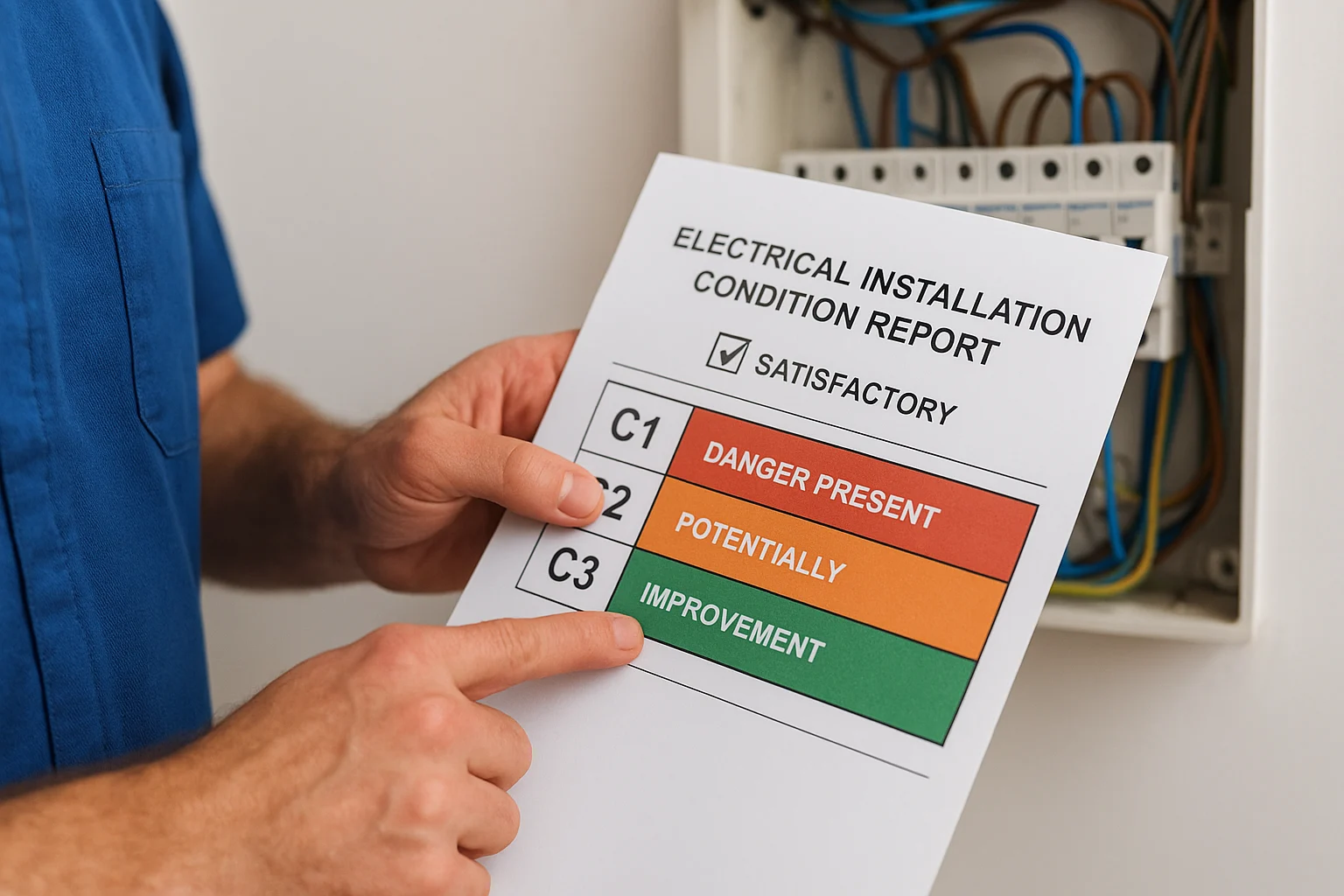
At the front of most EICR reports you’ll find a single overall result: satisfactory or unsatisfactory. This is the headline figure, but it’s really just a summary of everything found deeper in the document, so it’s worth reading past this page rather than stopping there.
Understanding the Observation Codes
The bulk of an EICR report is a schedule of individual observations, each assigned a code:
- C1 – Danger present. An immediate risk to life exists, and the report should specify that urgent action is needed straight away, sometimes even before the electrician leaves the property.
- C2 – Potentially dangerous. Not an immediate danger, but urgent remedial work is required to bring the installation up to a safe standard.
- C3 – Improvement recommended. Not a fault as such, but an area that doesn’t meet current wiring regulations and could be upgraded. A C3 alone does not make the report unsatisfactory.
- FI – Further investigation required. Something was found that the electrician couldn’t fully assess during the visit, and needs a follow-up before a final judgement can be made.
Any single C1 or C2 observation, or an FI that hasn’t been resolved, will typically push the overall result to unsatisfactory. A report with only C3 observations can still come back satisfactory, since these are recommendations rather than faults.
Why Older Properties Often Show More Observations
If you’ve received an EICR report full of C3s on an older property — particularly the Victorian and Edwardian conversions common across much of London — don’t panic. Older wiring and consumer units frequently fall short of current standards even when nothing is actually dangerous, simply because the regulations have moved on since the property was last rewired. This is normal, expected, and doesn’t automatically mean expensive remedial work is needed.
What to Do With an Unsatisfactory Report
If your EICR report comes back unsatisfactory, the electrician should have provided a written breakdown of exactly what needs fixing and why, referenced against the specific circuits affected. From there:
- Get a written, itemised quote for the remedial work, ideally from the same firm or a comparably qualified alternative
- Confirm the timescale — C1 and C2 issues should be treated as priority, not scheduled for “whenever’s convenient”
- Once the work is done, get written confirmation and, where relevant, an updated certificate showing the installation now meets the required standard
- Keep both the original report and the remedial confirmation on file together
EICR Reports and Fire Risk Assessment: Two Separate Documents
It’s worth being clear that an EICR report is not the same thing as a Fire Risk Assessment london. The EICR is narrowly focused on the condition of the fixed electrical installation in a single property, while a fire risk assessment takes in the whole building — escape routes, fire doors, alarm systems, and management arrangements. Landlords with HMOs or blocks of flats often need both documents, since faulty electrics are a recurring factor in accidental fires, but one can’t stand in for the other.
Getting a Report You Can Actually Trust
Because an EICR report carries legal weight for landlords, it’s worth choosing an electrician carefully rather than going with the cheapest quote available. Look for NICEIC or NAPIT registration, adequate public liability insurance, and — most importantly — a willingness to talk you through the report rather than just emailing over a PDF. If you’re based in the capital, a resource like this one on the electrical safety certificate London process is a useful starting point for understanding local pricing and typical turnaround times.
For those specifically searching for EICR London providers to compare, Liviosiv is another option worth adding to your shortlist alongside other registered local electricians.
Final Thoughts
An EICR report isn’t just a legal formality to file away unread — it’s a genuinely useful snapshot of your property’s electrical condition, provided you know how to read it. Understand the coding system, take C1 and C2 findings seriously, don’t be alarmed by a run of C3s on an older property, and always keep the report alongside any remedial confirmation so the full history stays together in one place.