What Is an FLV File Type? Everything You Need to Know
If you’ve seen a .flv file, you’ve most likely wondered, “What is this, why can’t I open it, and is it still useful today? However, most users don’t come in contact with .FLV files very often, although they were once widely used throughout the web. The FLV file meaning, origin, history, its demise, and how to open or convert it today will be disclosed.
What Is an FLV File?
FLV is a Flash Video. It’s a video file format that’s created to support Adobe Flash Player, which employed to be one of the most well-liked methods to have a look at videos, play games, and view animations directly inside an internet browser. An FLV file is dubbed a “container” format. This is just a file that’s not limited to a single type of data. Rather, a video track, an audio track and other optional content, such as subtitles and/or metadata, are contained in a single file. It’s like a box containing some smaller items neatly packed together, and a video player can open the box and play everything together in sync.
Most FLV files are encoded with a combination of the Sorenson Spark or VP6 video compression codecs, and MP3 or AAC audio compression codecs. This combination helped keep FLV files relatively small in size and look pretty darn good, which was a HUGE leap for those who remembered only about a decade ago, back when Internet connections were fairly slow.
Where Did FLV Come From?
FLV is a creation of Macromedia in 2002 using Flash, which was gaining in popularity. Later, Adobe acquired Macromedia, and after that FLV was an Adobe product. It was an actual problem cobbled together into a format that rapidly became popular. Before FLV, it was a cumbersome, slow, and erratic game to play on the web. Each site appeared to require further plug-ins to play, and videos would not always display. By providing a solution that was efficient enough to work with the comparatively slow Internet connections then in use, FLV revolutionized the streaming of video.
Why Was FLV So Popular?
FLV reigned supreme on the Web for nearly a decade. Adobe Flash Player had been installed in almost all computers, and so MIYAFP could basically expect users to be able to play FLV video on any site it was loaded on without installing any additional software. The reach was difficult if not impossible, to equal then.
That is why when YouTube was established in 2005, FLV was its official video format. This was the trend for years and was emulated by others such as Hulu and Vevo. Whether you knew this or not, if you watched video online at that time, it was certainly being played by an FLV file.
Video ads and embedded players on random websites, blogs, and forums were another area where FLV proved to be useful: smaller, faster to load, and compared to a website with the visitor flashed plugin already in place.
Why Did FLV Stop Being Used?
FLV’s fall is the fall of Flash Player. Around the same time, there were a few events that contributed to the collapse and the fall of the whole internet from Flash, and so FLV was put to rest as well. The mobile device had been the largest tipping point. At the time of the iPhone boom, Apple resolved to never make Flash Player a thing, and other phone companies followed suit. As more and more people surfed the web using cell phones, websites could not continue to use the one that didn’t work on all the phones.
At the same time, a new standard was broached known as HTML5, which was capable of running video without requiring any plugin. This meant that Flash Player and consequently FLV were almost obsolete. Security was also a consideration. Over the years, there were a lot of vulnerabilities with Flash Player; users and website owners alike were apprehensive of keeping Flash Player in their systems.
One by one, Adobe ended support for Flash Player at the end of 2020, and all major browsers followed soon after. The main point of FLV was that it was created specifically with the Flash language in mind, and was rendered moot when Flash became unavailable for good. YouTube, however, had already shifted away from FLV years back, as it adapted to the fact that Internet browsers and devices were evolving and needed a more recent format.
Is FLV Still Used Today?
While FLV is not an extinct format, it is certainly not a popular one these days. FLV is also still occasionally used when streaming live through older versions of broadcasting software, and RTMP-based streaming systems have to use it to stream behind the scenes. There are even files that were downloaded before the 2000s, websites that are saved, and personal video collections that were compiled during the early 2010s, which might still be in FLV format.
But for browsable purposes, FLV has been virtually replaced. The FLV format cannot be played by most phones unless they have additional software, cannot be opened by ordinary browsers, and cannot be uploaded to social media sites in any shape or form. Unless you’re doing some special trick with video software that streams, then the video should no longer be contained in FLV format. Delete unwanted content from an FLV file.
How to Open an FLV File
If you do not need to convert an FLV, but only watch it, a couple of other media players that do not require Flash Player can still play the FLV. The most popular one is VLC Media Player because it is able to play FLV files without additional plug-ins. Apart from that, a few third party video players can play FLV, such as KMPlayer. However, it’s not enough to simply play the file. While you might be able to open an FLV file on your computer, it won’t play on the majority of cell phones, social media websites and wouldn’t play back well in most video editors these days. This is where file conversion comes in handy.
FLV vs MP4: What’s the Difference?
FLV and MP4 might seem similar since they’re both video containers, but they’re built for very different eras of the internet.
| Feature | FLV | MP4 |
| Requires Flash Player | Yes | No |
| Works on smartphones | Rarely | Yes |
| Supported by social media | No | Yes |
| Browser support today | Very limited | Universal |
| Editing software support | Limited | Wide |
| File size efficiency | Decent for its time | Better, more modern compression |
To sum up, MP4 will do all the same things as FLV does, but better, and more widely supported. That’s precisely why video has come to be the standard format today, on nearly every website, smartphone, and smart TV.
FLV to MP4: How to do it?
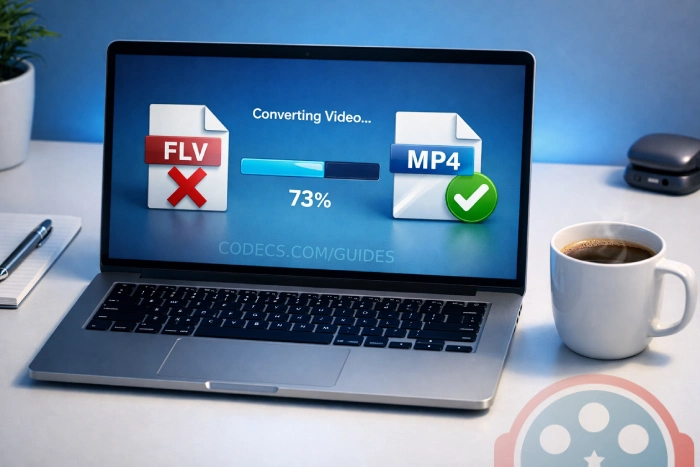
To use an old FLV file, converting FLV to MP4 is easy to do. It takes just a few minutes and, once complete, it will play on any phone with internet connectivity, a browser, and a platform without any problem.
Option 1: Convert FLV to MP4 Online (Easiest)
For most users, the easiest way to go about it is to utilize a free converter on the internet, as it requires no installation and has no configurations to work out. If you need to do this, then it helps to use a tool like AhaConvert. It is 100% browser-based, device-independent, and converts an FLV file to a clean MP4 file in seconds with a couple of clicks.
To convert FLV to MP4, please follow this simple step-by-step process on AhaConvert’s FLV Converter page:
- Open the FLV Converter tool on AhaConvert.
- Upload your FLV file from your device, or click the Drag and drop to the browser button.
- Choose MP4 as a format to convert to.
- Click on Convert and allow a few moments to elapse for processing.
- When it’s ready, download your brand new MP4 file.
No software or installation, no watermark, no baffling settings to navigate around. This is often the quickest solution to retrieve old footage, download files onto hard drives, or prepare footage for upload elsewhere.
Option 2: Convert FLV to MP4 With VLC
The conversion can be performed by VLC Media Player as well. Open VLC, click Media, Convert/Save, and add the FLV file. Click on Convert/Save one more time, select the Video – H.264 + MP3 (MP4) profile, select the save destination, and then click on Start. It’s working pretty well, but it will require a few more steps to use than a dedicated online converter. With HandBrake, you can convert FLV to MP4 at no cost.
Option 3: Convert FLV to MP4 With HandBrake
If you are looking for bigger control over resolution or file size, then HandBrake is a great free choice. Install the program, open your FLV file in File and Open Source, select a preset (Fast 1080p30), and hit Start Encode. A little more complex, but allows for optimization of the result if necessary. Here is a quick comparison of the different ways that Americans measure weight loss and gain.
- Method
- Best For
- Difficulty
- AhaConvert (Online)
- Fast, simple conversions
- Very Easy
- VLC Media Player
Users who already have VLC player can click here to install the VLC plugin.
- Easy
- HandBrake
- Advanced control over settings
- Moderate
When you don’t plan to convert a file many times, having an online tool like AhaConvert is the easiest and fastest, especially for most people.
Pros and Cons of FLV Files
FLV files had a significant role in early online video, but were not without some limitations. Knowing these pros and cons can enable their users to make the decision of whether to retain their FLV file or convert to a newer format like MP4.
| Pros | Cons |
| Small file size | Limited modern support |
| Good for older web videos | Flash Player is discontinued |
| Easy to stream on slow connections | Poor smartphone compatibility |
| Supported by older media players | Limited editing software support |
| Useful for archived videos | Not widely supported by browsers |
| Can be converted to MP4 | Less suitable for modern platforms |
Overall, FLV was efficient for its time, but modern formats such as MP4 are more practical today.
Conclusion
FLV was integral in the early years of online video, and enabled sites like YouTube to offer smooth playback before the Web was ready to handle it. However, when the Flash Player started fading fast, so did the FLV player, and as the Web as a whole takes on a whole new look today, so does FLV.
However, if you are still holding on to old FLV files, there’s no need to keep any of that format that works very little these days. They can be converted to MP4 in a matter of minutes and are on immediate use with any phone, browser, or platform you are going to use. The best option would be to upload your file to AhaConvert’s FLV Converter, select MP4, and download a version that will work for most people today.